
Sustainability Certifications
Washington College is certified as a bee-, bird-, and tree-friendly campus. Semans-Griswold Environmental Hall on the Waterfront Campus has been certified in the Living Building Challenge, a sustainable development model that is a step above LEED certification.
Certifications
Bee Campus
What It Means
As a Bee Campus, Washington College is ensuring a better future for our pollinators, our communities, and the planet. Bee Campus USA fosters ongoing dialogue to raise awareness of the role pollinators play in our communities and what each of us can do to provide them with healthy habitat.
The Bee Campus USA program endorses a set of commitments for creating sustainable habitat for pollinators and promotes research and curiosity.
College students, faculty, administrators, and staff have long been among the nation's most stalwart champions for sustainable environmental practices.
Natural Lands Project through CES
Restores native wildlife habitats throughout the bioregion, focusing on native meadows
that support native pollinators
Campus Arboretum
Promotes native plants, trees, and best practices to promote the welfare of insect
biodiversity.
Academic Pollinator Research
Students collaborate with professors on research projects involving pollinators from
a variety of perspectives.
Campus Garden
Students practice beekeeping at our Campus Garden apiary.
Permaculture Internship
Students research relationships between plants, pollinators, and local food production
systems.
Beekeeping 101 Course
The Lifelong Learning program teaches students how to become beekeepers and serve
as bee ambassadors to the public.
Programs and Guest Speakers
Public programs that educate students and the public about native bees and their importance.
- The Student Government Association maintains the certification for Bee Campus USA and collaborates with interdisciplinary classes to promote pollinator advocacy on campus.
- The Campus Grounds staff creates meadow plantings in place of lawns.
- The Campus Garden conducts honey extraction workshops and sells the honey as a fundraiser to purchase plants for pollinators.
- The Compost Team rebuilds soil as the basis for pollinator habitat.
- The Student Government Association organizes Casey Time which has included the planting of native flowering plants.
Bird Campus
What It Means
Becoming a Bird Campus means that the College demonstrated they are dedicated to helping reduce threats to birds while creating a healthier environment for students, employees, and birds alike. Aspects of the campus evaluated included bird habitat conservation, addressing major threats to birds, increasing conservation awareness both on campus and in the community, and supporting sustainable practices.
- Engaging in long-term efforts to create and conserve bird habitat through programs such as the Natural Lands Project (NLP).
- Currently partnering with American Bird Conservancy conducting research to test the effectiveness of bird-friendly glass patterns to reduce avian window collisions.
- Running Foreman's Branch Bird Observatory (FBBO), a high-volume migratory bird banding and monitoring station.
- Hosting lab classes, local bird clubs, and public education events on campus, at FBBO, and at the college's River and Field Campus, where students and the public can learn about bird research, conservation, and the importance of local wildlife in general.
- Having an active Washington College Bird Club on campus, providing students the opportunity to go on bird-watching field trips, and connect with each other on all things birds.
- Providing relevant classes to students such as ornithology, wildlife conservation, invasion biology, restoration ecology, environmental science, and environmental education.
- Hosting an annual Migratory Bird Day event on campus.
- Installing Feather Friendly glass decals on high-threat windows to reduce bird collisions at the waterfront campus.
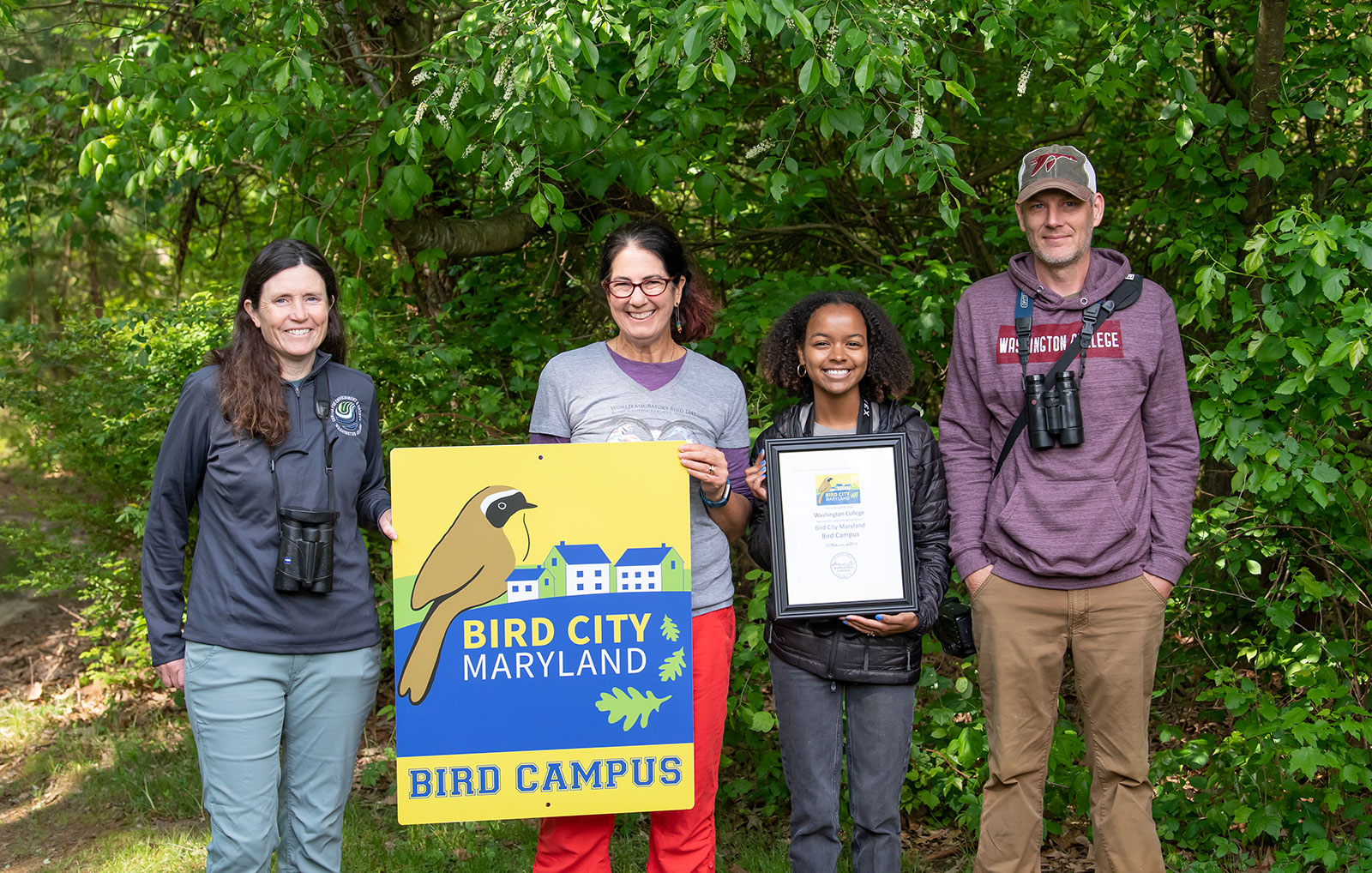
We would like to recognize Fana Scott for spearheading the Bird Campus Certification application process. Fana was a 2022-23 Chesapeake Conservation and Climate Corps (CCC) member at the Center for Environment & Society. She undertook on the certification process as her CCC capstone project, leaving a lasting impact on the college campus.
Tree Campus
What It Means
Tree Campus Higher Education recognition acknowledges Washington College has met five standards set by the Arbor Day Foundation: a campus tree advisory committee, a campus tree care plan, dedicated annual expenditures for the tree program, observance of Arbor Day, and engaging students in a tree-focused service learning project.
With more than 700 trees, the Virginia Gent Decker Arboretum is integrated into campus. Among noteworthy specimens are an impressive osage orange at the Owings Terrace outside Miller Library and a tulip poplar descended from one planted by George Washington at Mount Vernon and gifted to the College by the Mount Vernon Ladies' Association of the Union.
- Dr. Martin Connaughton
- Mallory Westlund
- Dan Small
- Laura Chamberlin
- Dr. Joseph Milligan
- Kathy Thornton
- Arboretum Intern: Ella Baldwin