
A 17th Century Themed Spring Break
Students follow in the footsteps of shipwrecked settlers from Bermuda to Jamestown and explore the oft-overlooked maritime link to the historic American colony.
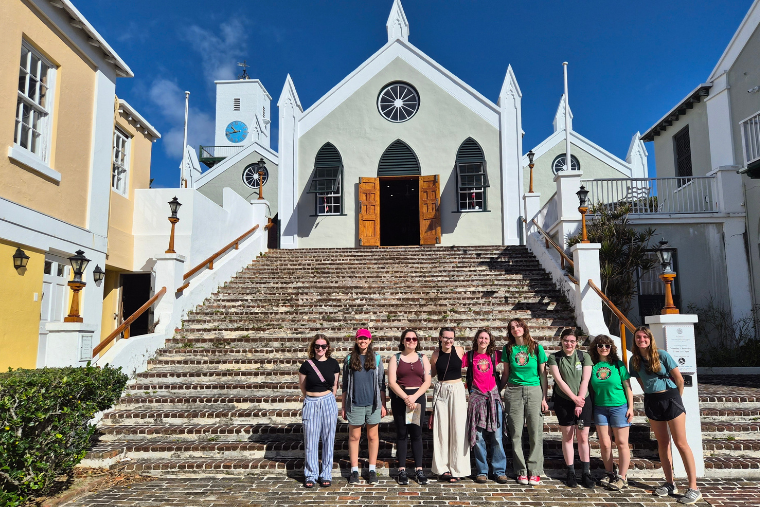
A trip to Bermuda for spring break would entice any undergrad, but this year several Washington College students embarked on an archeological trip over their holiday that would have them following in the footsteps of British settlers who shipwrecked on the tropical island in 1609 and, eventually, made their way to American shores and the Jamestown settlement in Virginia. The journey for the settlers was stark, harsh, and adventurous. For the nine students joining the Washington College Starr Center for the Study of the American Experience's Associate Director of Experiential Learning and Programs Victoria Barnett-Woods in their footsteps, it was eye-opening.
The week-long excursion was an enrichment trip organized by the Starr Center's Quill and Compass program, a scholarship program for students interested in history that awards both tuition support and experiential learning opportunities. The trip was sponsored by Chapter 1 of the Colonial Dames of America and the Society of the Colonial Wars in the State of Maryland. Barnett-Woods, a scholar of empire and the Atlantic maritime world, designed the expedition to run parallel to that of the 17th-century Virginia Company voyage of The Sea Venture. Students would first go to Bermuda and then head back to the Jamestown settlement.
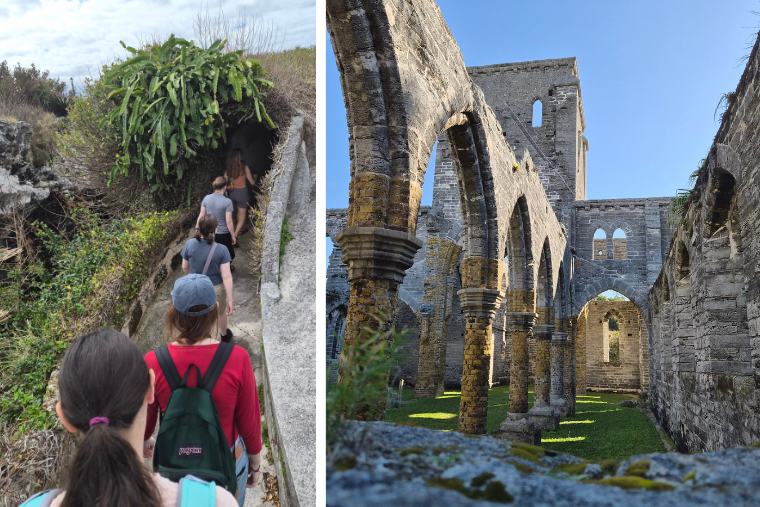
“Opportunities like this are exceptional for student development. Students were free to engage with the experience on their own terms and through their own intellectual lens and interdisciplinary focus,as well as have fun and delight in discovery,” commented Barnett-Woods, who prides herself on being an advocate for experiential learning to complement the important work being done in the classroom.“With these experiences, students are introduced to new communities, experts in their fields, cultural contexts and perceptions of the world and history that differ from their own.”
The Sea Venture, a 300-ton sailing ship belonging to the Virginia Company, was originally bound for the fledgling colony, but crashed on Bermuda in July 1609. The crew and Admiral Sir George Somers took possession of the then-uninhabited island, naming it Somers Isles. Many of the castaways were woman and children who made their home there. Though there are no people indigenous to the site, it had been previously discovered by Spanish explorer Juan deBermúdez around 1505. The original name "Bermuda"had been scribed on maps for a century, causing it to persist over the colonial name.
A few months into the unintentional settlement of Bermuda, the Virginia Company leadership felt compelled to finish their mission to Virginia, rebuilding smaller vessels out of the sunken Sea Venture's half-submerged hull. They made their way to Jamestown in November 1609. Many of the Bermudian settlers, however, stayed behind, and their names (Taylor, Hopkins, etc.) still feature prominently on the island. When the departing crew from the new ship landed in November of 1609, they arrived during Jamestown's "Starving Times," when over 450 settlers died and the remaining 50 struggled to survive; nearly 90% of the population perished. The crew shared what they could from the Bermudian vessel, which is why the Jamestown archeological record shows Bermudian fish and fowl amongst its artifacts. The crew that arrived in Jamestown that November did a great deal to save the colony from utter ruin. In many ways, we have the island of Bermuda to thank for the enduring legacy of Jamestown.
Washington College students paralleled this historic voyage,arriving in Bermuda and staying at the National Museum of Bermuda where they not only toured the grounds but also spent three nights inside the museum. Students met lead archaeologist and professor of history at Rochester University, Michael Jarvis, and toured the archaeological lab at Saint George's Parish. Bermudian national archivist Karla Ingemann oriented students in the archives where they looked at primary source materials connected to early Bermudian history in the capital city of Hamilton.
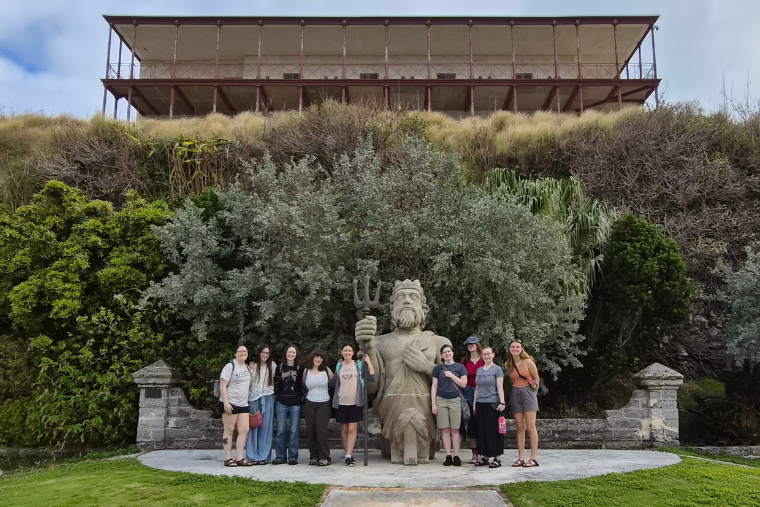
“Bermuda's laws around archaeology are very different than America's,” said Sophia Clark ‘28. “When I heard that I was a little nervous. But it turns out that the Bermudian government is very good about ensuring that archaeology that is done there benefits the people, the culture, and the lives of Bermudians, over the kind of exploitive archaeology that other countries in the Southern hemisphere have suffered. I thought that was really interesting.”
Clark is a history major with two minors: museum, field, and community education, and medieval and early modern studies. “Seeing places like this is really important to understanding history,” said Clark who was drawn to the trip for the opportunity to experience history instead of just taking the way in which it was presented to her, especially colonial history.
After their time in Bermuda, the students then flew back to the U.S. and headed down to the historic Jamestown Settlement in Virginia, studying the influence Bermuda had over the colonial infrastructure of the settlement and the different ways the museums represent their colonial history to a public audience. Barnett-Woods felt it was important for students to see firsthand how critical Bermuda was to the colonial infrastructure of Jamestown and yet is often dismissed from the larger narrative.
Julianna Nelson-Gaudette ‘28, an English and French double major, was personally struck by the framing of the same history in the Jamestown settlement versus how it was described in the Bermuda exhibits.
“Without going and experiencing these things and [personally] interpreting both sides, my understanding of those events would be pretty singular to what is displayed in Jamestown,” said Nelson-Gaudette, who enjoyed being around the professionals at the Bermuda National Archives and learning about the methods and tools that they use to collect and digitize artifacts. She also said she appreciated traveling with students whose interdisciplinary studies could help deepen her own understanding of history.
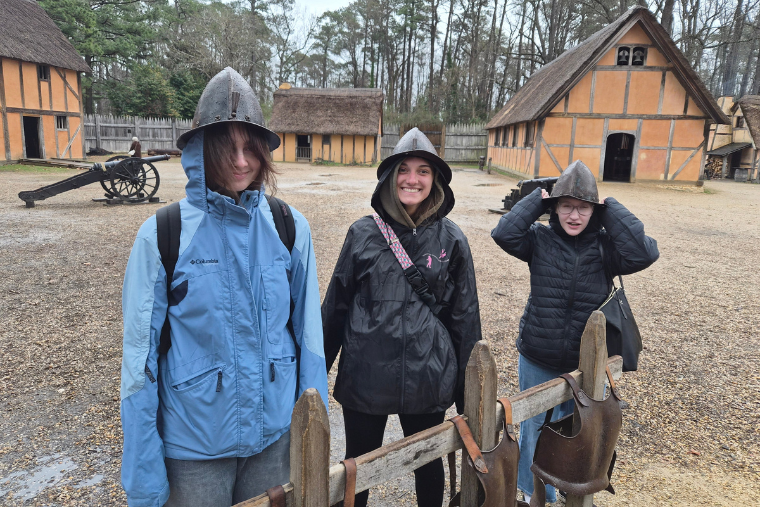
While in Jamestown, a huge snowstorm developed with temperatures dropping below freezing. The sudden weather change allowed the group to draw parallels between their spring break trip and the voyage of the Sea Venture—though it wasn't the “Starving Times” the group went from enjoying an idyllic tropical island life in Bermuda to freezing inhospitable conditions in Virginia.
Annabella Goglia ‘27, a history major minoring in English, wanted to go on this trip due to her fascination with American history that took place outside the continental U.S.—a branch of study she feels is discussed infrequently.
“Trips like these are important,” said Goglia, lauding the chance to visit places where history happened rather than just reading about it in a book. “It feels like the difference between hearing a description of someone and actually meeting somebody.”
Clark remembered feeling odd when she read that the settlers heard sea birds calling as they approached the Bermudian coast and thought the island was one of “devils.” But as she walked around the coast on the island,she was struck by those same strange bird calls and thought how shocking it would be to hear them as you wrecked on an island.
“Seeing places like this is really important to understanding history,” she said.
Goglia agreed. “Not everyone learns as well as others by just reading something. Tangible experiences stick much better for a lot of people,” she said, lauding the experiential trip.
Over the course of the trip, the many stops opened up discussion of how living history, as a medium of public history, invents the past for public engagement.
“This kind of engagement is really only possible when staff and faculty leaders have the time and opportunity to develop programming, secure resources, and nurture the relationships necessary to make a trip like this a success,” said Barnett-Woods, who feels that this is something Washington, as a flexible and student-focused liberal arts school, does incredibly well. Several students plan on taking this experience and moving forward with it by either returning to Bermuda or integrating their newly acquired knowledge into their future senior capstone experiences.
The journey ended in Colonial Williamsburg with a ghost tour—a bit of fun to round out an altogether intellectually provocative experience.
This expedition is one of many experiential learning opportunities that Washington College students. To learn more visit the Centers of Excellence.
- Christine Sinatra