George H. W. and Barbara Bush speak at Washington College
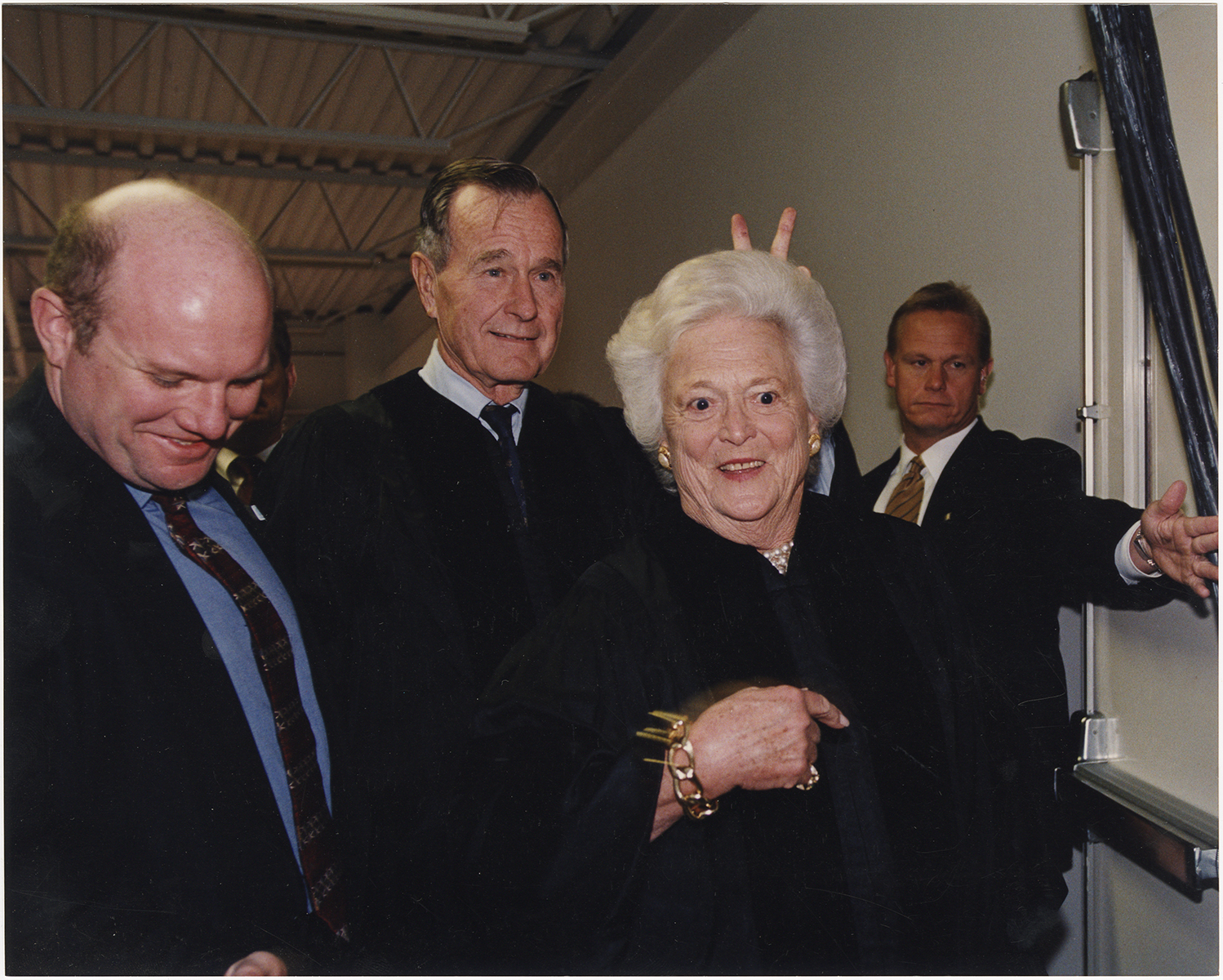
The Bushes’ visit to Washington College provides an example of political civility that has been lacking in recent years.
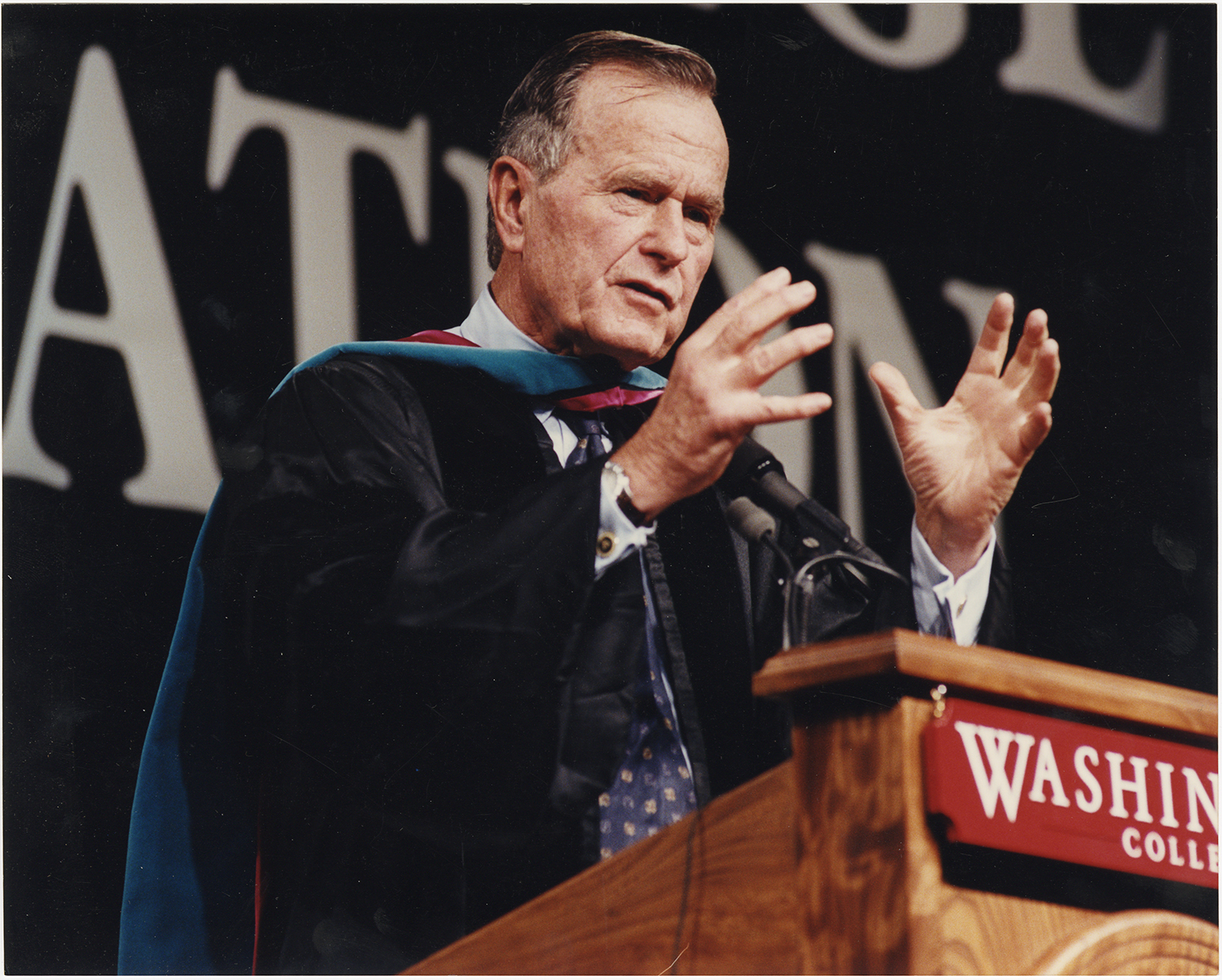
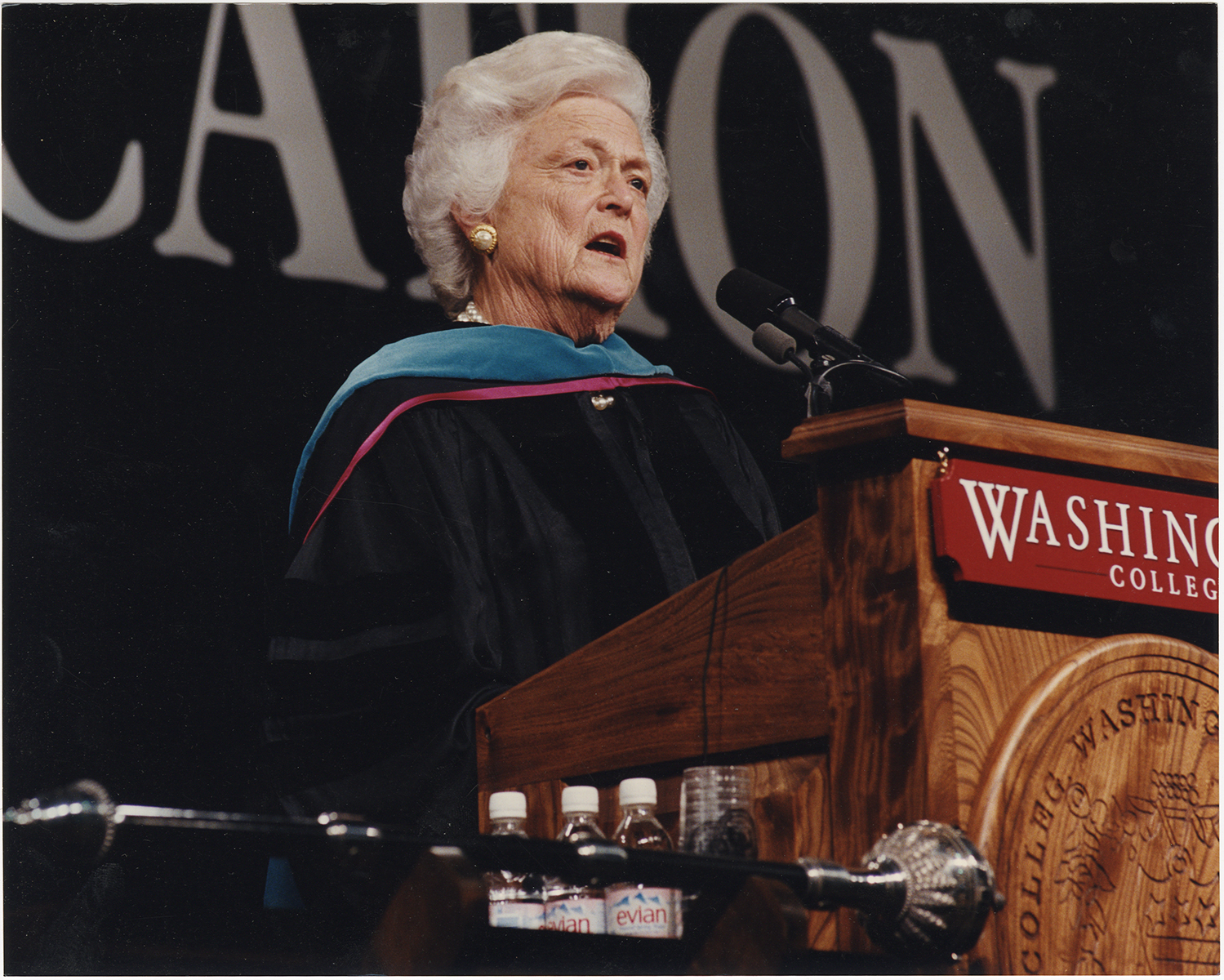
In January 1999, six years after his presidency, George H. W. Bush and his wife Barbara joined Dr. James Watson, one of the co-authors of the definitive paper on DNA, on the Convocation stage to receive honorary degrees; Watson for Science and the Bushes for Public Service. The Washington Birthday Convocation ceremony is a smaller, more intimate affair than Commencement, and has sometimes offered a question-and-answer session with its honorees. The opportunity for students and community members to ask a former president questions is a chance not to be missed. This convocation occurred at a significant point in American politics. A former Republican President was given a platform while a sitting Democratic President faced impeachment and a salacious sex scandal. The opportunity to disparage a political opponent and score social media points is what we would expect today. Some at the time would have expected a few jokes at Clinton's expense. But on that stage, before the student body and future citizen leaders of Washington College, the Bushes took a different tack. They avoided the questions, relied on humor, and focused on legacy.
In recent years, it seems as though political discourse has only been divisive. There is no middle; it is only us vs. them, and they will never see that they are wrong. We can hope that the pendulum can swing, and that we, as a nation, can find common ground on what is right, just, and humane, for that is the only way forward. We are not wrong in feeling the animosity around us; the 2016 election will go down as one of the most politically adversarial in our nation's history. But there have been others.
We can go back to the early days of our government to find some examples, such as the Presidential election of 1800, with candidates Thomas Jefferson and John Adams. This election pitted two friends and Revolutionary heroes against each other. The primary issue, one that still rages, is how much control the government should have. Infighting within parties, smear campaigns, and an Electoral College debacle threatened to destroy the new nation. It took a second election with 36 ballots before Thomas Jefferson was declared the winner. Despite the cantankerous election campaigns, this marked the first time an incumbent lost and peacefully transferred power. Sadly, only twenty-four years later, two even more politically divisive elections would take place, this time between Andrew Jackson and John Quincy Adams. The pair faced off in the 1824 election, which Adams won, and again in 1828, where Jackson won the office. These were campaigns of mudslinging, personal attacks, and accusations of corruption that ran rampant. Sadly, these types of campaigns would become the norm rather than an aberration.
As the nation moved closer to civil war, the houses of Congress were not immune to hate and violence. As the debate over the Compromise of 1850 raged, Mississippi Senator Henry Foote berated his opponent, Thomas H. Benton of Missouri, so persistently that Benton came at Foote, who backed away and pulled out a pistol. Several other Senators were able to wrestle the gun away. Six years later, another act of violence would take place. On May 22nd of 1856, Rep. Preston Brooks of South Carolina would attack Sen. Charles Sumner of Massachusetts, an abolitionist, with his cane so violently that Sumner nearly died. The attack was retaliation for a fiery speech Sumner gave against slave holders, including Brooks's relative, South Carolina Sen. Andrew Butler. In February of 1858, a brawl took place on the floor of the House of Representatives. Between thirty and fifty congressmen fought over the Bloody Kansas debate and slavery. (Watch Johnny Knoxville portray Brooks for Drunk History) It is unsurprising that our nation suffered a seismic split that bled out into the citizenry and led to a civil war. While the physical fighting may have ceased, the mudslinging continued. This can be seen in the 1884 Presidential election between Grover Cleveland and James G. Blaine. This was an election where personal attacks superseded talk of actual issues.
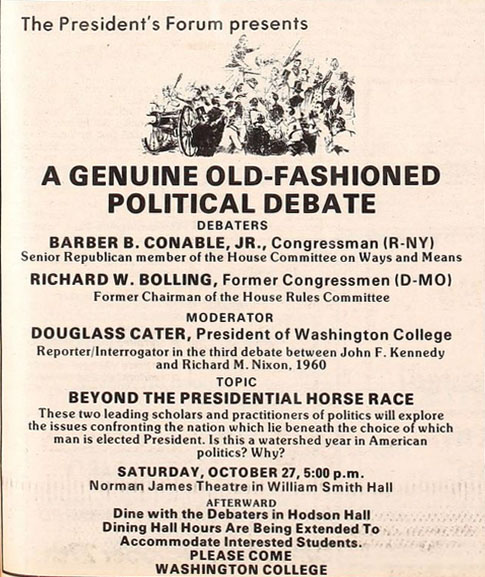 For an example of how our political discourse has shifted, you can listen to “Beyond the Presidential Horse Race,” a debate moderated by Washington College President Douglass Cater, between Barber
B. Conable, Jr. (R-NY) and Richard W. Bolling (D-MO) regarding the 1984 Presidential
election between Ronald Reagan and Walter Mondale. While the two Representatives trade
light-hearted barbs, they stick mainly to the issues and the facts. It's a refreshing
listen. Our political choices are reflective of our ideals, values, and aspirations.
Often, we see our choices as the lesser of two evils or the devil you know. It is
important to examine the conduct and ideals of our political candidates at every level
of government, and if you don't see one that inspires you, then become the candidate.
We must also hold our officials accountable for their conduct, and with the power
of the ballot and social media, we can do this. If the stress of modern political
discourse is making you doubt our democracy, then say so. Demand that the issues be
heard.
For an example of how our political discourse has shifted, you can listen to “Beyond the Presidential Horse Race,” a debate moderated by Washington College President Douglass Cater, between Barber
B. Conable, Jr. (R-NY) and Richard W. Bolling (D-MO) regarding the 1984 Presidential
election between Ronald Reagan and Walter Mondale. While the two Representatives trade
light-hearted barbs, they stick mainly to the issues and the facts. It's a refreshing
listen. Our political choices are reflective of our ideals, values, and aspirations.
Often, we see our choices as the lesser of two evils or the devil you know. It is
important to examine the conduct and ideals of our political candidates at every level
of government, and if you don't see one that inspires you, then become the candidate.
We must also hold our officials accountable for their conduct, and with the power
of the ballot and social media, we can do this. If the stress of modern political
discourse is making you doubt our democracy, then say so. Demand that the issues be
heard.
 The legacy of every president is complicated and can change from their time in office
as the nation evolves, time moves forward, and perspectives shift. We all do what
we believe is right in the moment and must live with the consequences, and those who
command the highest office are no different and face the harshest judgment. It is
also what they do after office that can secure a legacy; we only need to look at the
life of Pres. Jimmy Carter as an example that the work we do outside government can
be just as, if not more, impactful to the lives of everyday people around the world.
Whatever opinion there may be of President G. H. Bush, on that stage in 1999, he took
the high road.
The legacy of every president is complicated and can change from their time in office
as the nation evolves, time moves forward, and perspectives shift. We all do what
we believe is right in the moment and must live with the consequences, and those who
command the highest office are no different and face the harshest judgment. It is
also what they do after office that can secure a legacy; we only need to look at the
life of Pres. Jimmy Carter as an example that the work we do outside government can
be just as, if not more, impactful to the lives of everyday people around the world.
Whatever opinion there may be of President G. H. Bush, on that stage in 1999, he took
the high road.
You can watch the entire January 29, 1999, Convocation on our Digital Archive.